Have you ever met someone who makes you feel truly alive? Suddenly, things that once seemed confusing begin to make more sense, colors appear brighter, everyday experiences feel more meaningful, and thoughts of one special person seem to occupy your mind throughout the day. These powerful emotions are often associated with what many people describe as the honeymoon phase of a relationship, a period characterized by heightened attraction, excitement, and emotional intensity.
Yet for many couples, what begins as an exhilarating rush of passion eventually gives way to a different reality. The butterflies become less frequent, routines begin to replace novelty, and an important question emerges: What happened to the passion? Understanding that question begins with understanding how love changes over time.
One of the most influential explanations comes from psychologist Dr. Robert Sternberg’s Triangular Theory of Love, which proposes that love is built from three interrelated components: passion, intimacy, and commitment (Sternberg, 1986). Nearly four decades after its introduction, Sternberg’s theory continues to be widely studied and applied. A recent scoping review concluded that the model remains both theoretically coherent and empirically supported, with passion, intimacy, and commitment consistently linked to relationship satisfaction, relationship seriousness, and sexual satisfaction (Durão & Conde, 2026).
How Sternberg’s Theory Explains the Honeymoon Phase
According to Sternberg (1986), passion encompasses the physical attraction, romantic excitement, physiological arousal, and desire that people often associate with being in love. Of the three components, passion is frequently the most prominent during the honeymoon phase.
The heightened excitement associated with new love is not merely psychological. Research suggests that romantic love activates neural systems involved in reward, motivation, and pleasure. These systems are heavily influenced by dopamine, a neurotransmitter associated with anticipation, reward, and goal-directed behavior. As a result, individuals often experience heightened energy, focused attention on their partner, and intense feelings of excitement during the early stages of a relationship (Acevedo et al., 2012; Carswell & Impett, 2021). This helps explain why the honeymoon phase can feel so exhilarating and consuming. However, Sternberg (1988) argued that passion alone is rarely sufficient to sustain long-term love. As relationships mature, two additional components become increasingly important.
Intimacy refers to feelings of closeness, trust, emotional connection, and mutual understanding. Commitment reflects both the decision to love someone and the determination to maintain that relationship over time (Sternberg, 1986). While passion often initiates a relationship, intimacy and commitment help transform early attraction into a deeper and more enduring bond.
Importantly, Sternberg’s model suggests that moving beyond the honeymoon phase does not represent a decline in love. Rather, it reflects a shift in the balance among passion, intimacy, and commitment as couples continue to grow together.
Consummate Love: The Balance of All Three Components
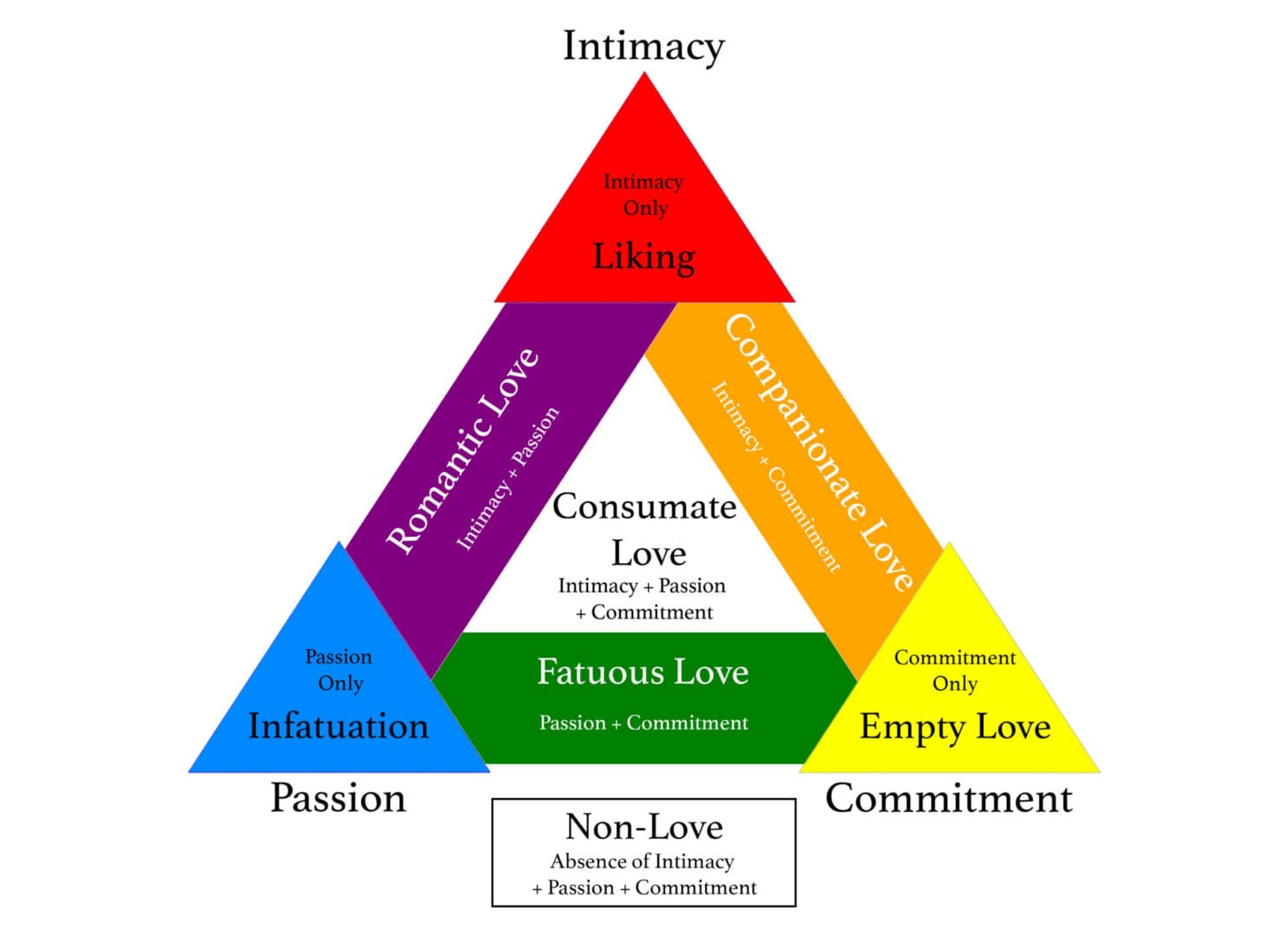
To illustrate his theory, Sternberg conceptualized love as a triangle, with each side representing one of the three components. Different combinations of passion, intimacy, and commitment produce different forms of love (Sternberg, 1988).
These forms include:
- Non-Love: Absence of passion, intimacy, and commitment.
- Liking: Intimacy without passion or commitment.
- Infatuated Love: Passion without intimacy or commitment.
- Empty Love: Commitment without passion or intimacy.
- Romantic Love: Passion and intimacy.
- Companionate Love: Intimacy and commitment.
- Fatuous Love: Passion and commitment.
- Consummate Love: Passion, intimacy, and commitment together.
Among these, consummate love represents the fullest expression of romantic love because all three components are present simultaneously (Sternberg, 1986). Yet Sternberg (1988) also recognized that consummate love can be difficult to maintain over time.
Of the three components, passion is often the most elusive. Intimacy tends to grow through emotional connection, trust, and shared experiences. Commitment can deepen through intentional choices and investments in the relationship. Passion, however, is more dynamic. It often fluctuates as couples navigate the realities of everyday life, including work demands, parenting responsibilities, stress, health challenges, and familiar routines. As a result, many couples find themselves enjoying strong intimacy and commitment while longing for the intensity and excitement they experienced during the honeymoon phase.
This does not mean the relationship has failed. Rather, it reflects one of the central challenges of long-term love. Research suggests that passion is influenced by novelty, personal growth, emotional connection, and meaningful relationship experiences (Carswell & Impett, 2021). The challenge for many couples is not simply preserving the feelings of early romance, but intentionally creating opportunities for passion to be renewed while intimacy and commitment continue to deepen. In this sense, consummate love is less a destination that couples permanently arrive at and more an ongoing process of nurturing passion, intimacy, and commitment throughout the life of the relationship.
Why Passion Matters Beyond the Honeymoon Phase
Many couples eventually find themselves wondering what happened to the excitement they felt at the start of their relationship. The transition from early romance to long-term partnership often brings changes in how passion is experienced and expressed.
According to Sternberg (1986), passion is the motivational component of love associated with romance, physical attraction, and sexual desire. The factors that sustain passion, however, can differ substantially from person to person. While some individuals derive passion primarily from physical attraction, others may experience passion through emotional closeness, admiration, support, shared goals, or opportunities for self-development within the relationship (Carswell & Impett, 2021).
When passion decreases, emotional distance may sometimes increase as well. Because the three components of love are interconnected, changes in one component often influence the others. Fortunately, research suggests that passion is not simply something that fades with time. Rather, it can be strengthened through shared experiences that foster novelty, personal growth, emotional connection, and opportunities for couples to continue discovering one another (Carswell & Impett, 2021).

Self-Expansion and the Renewal of Passion
One particularly helpful framework for understanding long-term passion is self-expansion theory, which proposes that individuals are motivated to grow, learn, and expand their sense of self through close relationships. Contemporary reviews of romantic passion suggest that opportunities for novelty, growth, and shared experiences may help sustain passion over time, even after the initial excitement of a relationship has changed (Carswell & Impett, 2021). More recent scholarship continues to support the idea that close relationships serve as important opportunities for self-expansion and personal growth (Emery et al., 2025).
These findings align with self-expansion research demonstrating that couples often report greater passion and relationship quality when they engage in novel and challenging experiences together (Aron et al., 2000).
Couples often experience increased passion when they:
- Travel and explore new environments together.
- Learn new skills as a team.
- Pursue shared goals.
- Engage in challenging or exciting activities.
- Create experiences that break established routines.
These findings are especially meaningful when viewed through Sternberg’s framework. While the honeymoon phase naturally provides novelty, couples can intentionally continue creating opportunities for growth, thereby supporting the ongoing development of passion alongside intimacy and commitment.
Moving Beyond the Honeymoon Phase
One of Sternberg’s most enduring contributions is the recognition that love is not a single feeling but a dynamic process involving passion, intimacy, and commitment. Rather than remaining fixed, these components change over time as relationships develop and partners encounter new challenges, opportunities, and stages of life.
From this perspective, the end of the honeymoon phase should not be viewed as the end of love. Instead, it often marks the beginning of a new chapter in which emotional intimacy deepens, commitment strengthens, and passion evolves into a more stable and sustainable form. As Sternberg (1988) argued, enduring relationships are not sustained by intense feelings alone. Lasting love requires intentional choices, ongoing effort, and a willingness to continually invest in the relationship.

Commitment After the Honeymoon Phase
This idea aligns closely with the concept of sliding versus deciding. Research on relationship commitment suggests that major relationship transitions often produce healthier outcomes when they result from intentional decisions rather than simply drifting into increased levels of commitment (Stanley et al., 2006). The excitement of the honeymoon phase may help two people enter a relationship, but long-term relationship success depends on the decisions partners make after the initial rush of attraction begins to change.
In many ways, this reflects what may be called resilient commitment: the ability to remain dedicated to a relationship not only when love feels effortless, but also when life becomes complicated and the early chemistry no longer carries the relationship on its own. Commitment is strengthened when partners continue to prioritize one another, maintain emotional connection, and work toward shared goals. As Stanley, Rhoades, and Whitton (2010) note, commitment plays a critical role in helping couples maintain and secure attachment over time.
Recent research also suggests that commitment functions best when it is mutual. Studies examining asymmetrical commitment, or differences in partners’ levels of commitment, suggest that relationships can face greater challenges when one partner is substantially more invested in the future of the relationship than the other (Stanley et al., 2018). This work highlights an important lesson: healthy relationships require not only commitment itself but also shared commitment. Partners who clearly communicate their intentions and continually invest in one another may be better positioned to navigate the transition from early passion to enduring love.
Conclusion
Ultimately, the honeymoon phase may provide the spark, but passion alone cannot sustain a relationship indefinitely. Intimacy creates connection, commitment provides stability, and passion contributes energy and desire. The challenge for many couples is not developing intimacy or commitment, but continuing to cultivate passion as the relationship matures.
When all three components are intentionally nurtured, couples create the conditions for what Sternberg called consummate love: a relationship characterized not only by excitement, but also by trust, security, partnership, and enduring connection. In this way, the transition beyond the honeymoon phase is not the loss of love. Rather, it may be the point at which love becomes a deliberate and lasting choice.
References
- Acevedo, B. P., Aron, A., Fisher, H. E., & Brown, L. L. (2012). Neural correlates of long-term intense romantic love. Social Cognitive and Affective Neuroscience, 7(2), 145–159.
- Aron, A., Norman, C. C., Aron, E. N., McKenna, C., & Heyman, R. E. (2000). Couples’ shared participation in novel and arousing activities and experienced relationship quality. Journal of Personality and Social Psychology, 78(2), 273–284.
- Carswell, K. L., & Impett, E. A. (2021). What fuels passion? An integrative review of competing theories of romantic passion. Social and Personality Psychology Compass, 15(8), e12629.
- Durão, A., & Conde, A. (2026). Understanding love in couple relationships: A scoping review of Sternberg’s triangular theory. Psychological Reports. Advance online publication.
- Emery, L. F., Hughes, E. K., & Muise, A. (2025). Self-expansion theory: Origins, current evidence, and future horizons. Social and Personality Psychology Compass, 19(9), e70082.
- Rozalowski, S. & Sibley, D. S. (2026, February 4th). Beyond the butterflies: The journey of thehoneymoon phase. [Blog post]. Decide to Commit.
- Stanley, S. M., Rhoades, G. K., Kelmer, G., Scott, S. B., Markman, H. J., & Fincham, F. D. (2018). Unequally into “Us”: Characteristics of individuals in asymmetrically committed relationships. Family Process, 57(4), 975–991.
- Stanley, S. M., Rhoades, G. K., & Markman, H. J. (2006). Sliding versus deciding: Inertia and the premarital cohabitation effect. Family Relations, 55(4), 499–509.
- Stanley, S. M., Rhoades, G. K., & Whitton, S. W. (2010). Commitment: Functions, formation, and the securing of romantic attachment. Journal of Family Theory & Review, 2(4), 243–257.
- Sternberg, R. J. (1986). A triangular theory of love. Psychological Review, 93(2), 119–135.
- Sternberg, R. J. (1988). The triangle of love: Intimacy, passion, commitment. Basic Books.
Discover more from Decide To Commit
Subscribe to get the latest posts sent to your email.

I am an associate professor at Northern Illinois University in Human Development and Family Sciences, and a licensed Marriage and Family Therapist. As a researcher I am interested in commitment in couple relationships, romantic relationship formation, marriage, and decision-making in the emerging adult (18-29 year-old) population.

Hi! My name is Olivia Paluzzi and I am a senior at Northern Illinois University, majoring in Human Development and Family Sciences with an emphasis in Family Social Services and a minor in Counseling. After graduation, I plan on moving to Florida to pursue my master’s degree and work as a child and family therapist.